Cake Decorating Tools Worth Buying First (and What to Skip)
As an Amazon Associate I earn from qualifying purchases.
Walk into a baking supply store or scroll a marketplace and you will find hundreds of cake decorating products, most of which you do not need and some of which will actively slow your learning. The genuinely necessary kit is small, inexpensive, and stable: decorators fifty years ago used essentially the same core tools that professionals reach for today. Buying that core first, and resisting the themed gadget sets, gets you decorating real cakes within a week for roughly the cost of a single bakery cake.
The first purchase, and the one that changes results most, is a turntable. Smooth coats and even piping are rotational skills: you hold the tool still and spin the cake, and trying to decorate a stationary cake is why beginners struggle. A basic plastic turntable works; a heavier metal one with smooth bearings is a lifetime tool if the budget allows. Alongside it, buy a metal bench scraper, which is the tool that actually creates smooth, straight sides, and a medium offset spatula, whose bent blade keeps your knuckles out of the frosting while spreading and lifting. These three items are the smoothing system, and no substitute combination works as well.
The second cluster is piping equipment, kept deliberately minimal. A pack of disposable piping bags or two reusable ones, a coupler, and four tips cover almost everything: a large round tip, a large open star, a medium star, and a small round for writing. This modest set pipes swirls, rosettes, shells, borders, dots, and letters, which is most of the piped decorating that ever appears on home cakes. The hundred-piece tip sets are a classic beginner trap: nearly identical tips in bulk, mostly unused forever. Add a serrated knife for leveling if your kitchen lacks a long one, and cake boards in the sizes you bake, because decorating on the serving plate makes every step harder.
The third cluster costs little and prevents daily frustrations: gel food colors in primary colors plus white, parchment paper, a small sieve for dusting, and a couple of squeeze bottles if drip cakes appeal to you. Good pans deserve a mention here too, since straight-sided, light-colored pans in matching sizes produce layers that need less trimming, and two or three shallow pans beat one deep pan for even baking. None of this is glamorous, and all of it gets used every single bake.
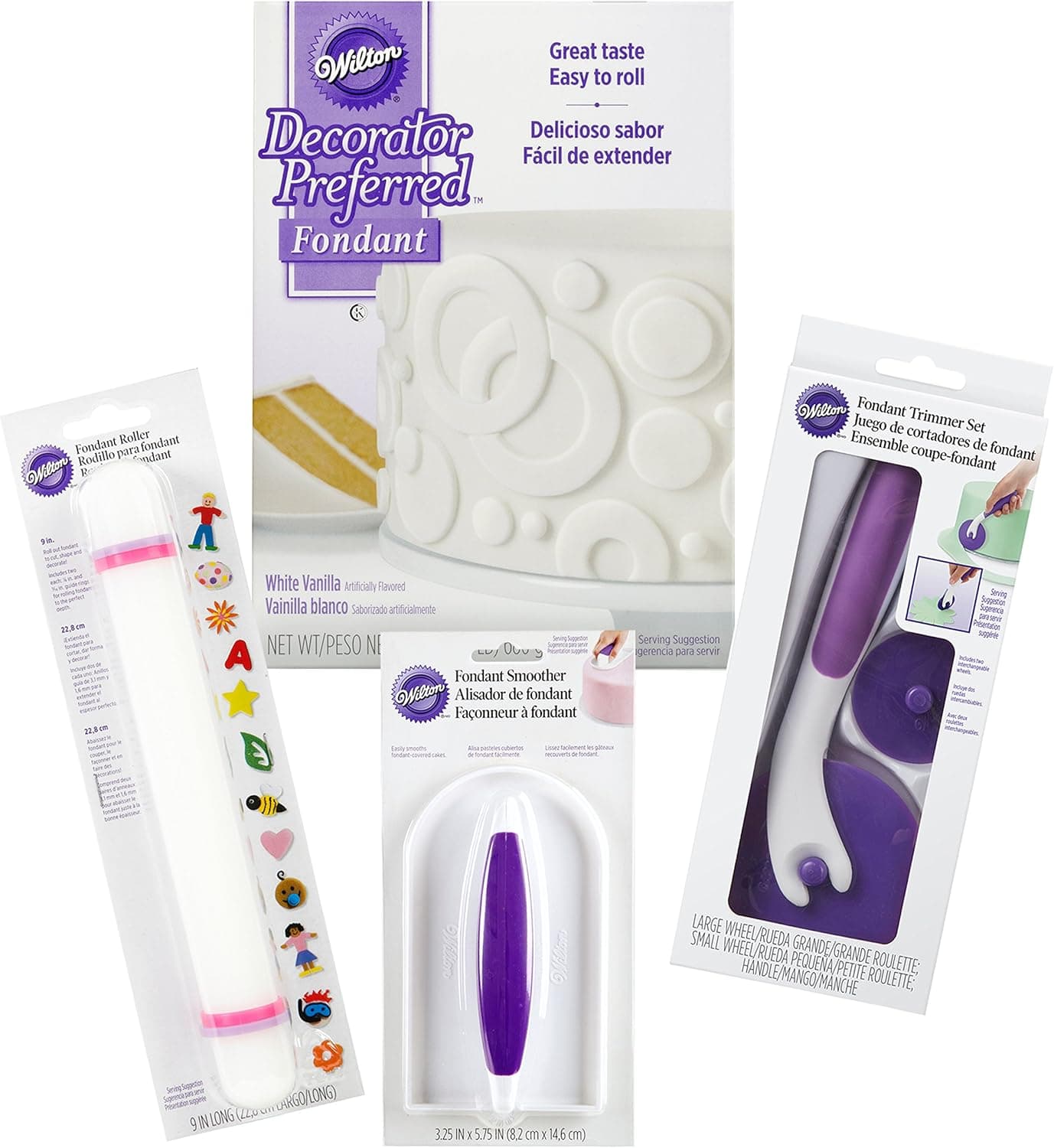
What can wait is a longer list. Fondant tools, smoothers, and cutters wait until you actually work with fondant. Airbrushes, Russian tips, flower nails, and modeling tool sets are technique-specific purchases that make sense only when that technique calls to you. Stand mixers are wonderful but not gatekeeping: a hand mixer makes excellent buttercream. Cake levelers, strip sets, edible printers, and most themed gadgets solve problems you either do not have yet or can solve with the knife and scraper you already own. The reliable rule: buy tools when a specific planned cake demands them, never speculatively.
When you do buy, spend where contact with the cake happens and save everywhere else. A flexing scraper cannot make straight sides, a wobbling turntable cannot make even ones, and a flimsy offset spatula fights you; these three reward quality. Piping bags, boards, and colors are consumables where cheap is fine. Store the kit together in one box so decorating starts with reaching for one container rather than a scavenger hunt. A focused kit does something subtler than save money: it removes the excuse layer between you and practice, and practice, not equipment, is what actually decorates cakes.